Evolution, Prevention and Relief of Acute and Chronic Pain with the Application of Diapulse® Therapy (Pulsed High Peak Power Electromagnetic Energy)
By Jesse Ross
Published reports from many parts of the world demonstrate the ability of Diapulse Therapy to prevent acute pain and eliminate chronic pain. When trauma is induced, three processes are triggered. The first is electrical, the second is electro-chemical, and the third is chemical. Diapulse Therapy accelerates the return of electrical charge to damaged tissue, as well as the electro-chemical and chemical response. Therefore Diapulse Therapy accelerates the healing processes by as much as 50%.
Key Words: Acute Blood Flow, Chronic Edema, Electrical Energy Stability, Electro-chemical Harmonic Frequency, Hematoma Inflammation, Inflammatory Process, Local Defense Mechanism, Mast Cell, Micro-circulation, Primary, Secondary, Stress Trauma.
I have been lecturing in the USA and Europe for the past twenty-five years, on the biophysical effects of electromagnetic energy and its application in medicine. Pain has always been a “side-issue” because of its subjectivity. Concentration has only been on the objective aspects of inflammation and bone and tissue healing. However, the researchers who performed clinical studies with Diapulse reported dramatic relief of pain as a beneficial side effect. In analyzing these reports for this presentation, and conducting an extensive review of medical literature on pain, I am presenting the following observations:
Although pain has been analyzed, psychoanalyzed, dissected, and treated extensively, with the use of chemotherapy, physiotherapy, bio-feedback, acupuncture, electro-therapy, hypnosis, surgery, psychology, the answer is the same:
There is still no complete scientific understanding of pain.
We are told that the cost of all chronic pain syndromes has been placed at $40 billion per year in America, and an equal amount in Europe. John Bonica, founder of the first multi-disciplinary pain center in the United States, at the University of Washington, suggests that 86 million Americans have some kind of chronic discomfort.
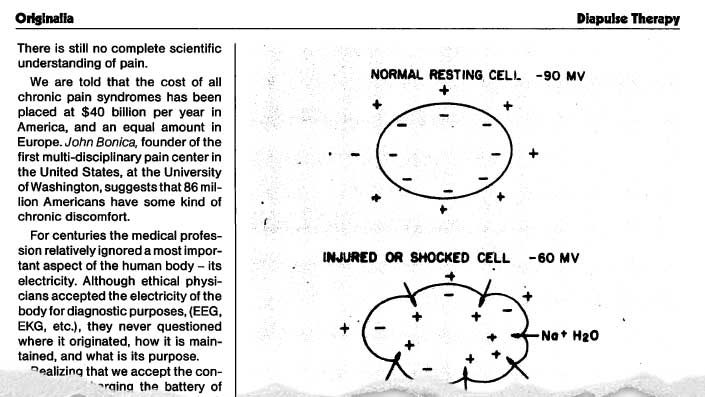
For centuries the medical profession relatively ignored a most important aspect of the human body – its electricity. Although ethical physicians accepted the electricity of the body for diagnostic purposes, (EEG, EKG, etc.), they never questioned where it originated, how it is maintained, and what is its purpose.
Realizing that we accept the concept of re-charging the battery of our automobile when it is required, we can consider the fact that every living cell is a miniature battery, which when discharged, can be assisted to be re-charged by external methods. Let us apply this principle:
The first reaction to stress is electrical; the second is electro-chemical; and the third is chemical.
The first reaction can be best illustrated by placing the hands behind the back of a patient, taking a needle, and pressing it into a finger. The patient will be able to state exactly where the needle has intruded. The intrusion is recognized through nerve endings to the spinal cord, to the brain which receives the signal. All of this is instantaneous. The brain, by electrical transmission, orders a response to blood flow, antibodies – enzymes, etc. The signal is transmitted either by electromagnetic, or electrical response of the nervous system. Each component of the body operates on a different harmonic frequency and in this way, is able to communicate with the master control – the brain – which in turn, electrically orders various parts of the body to respond to the particular stress involved.
The electro-chemical reaction is a local defense mechanism response to maintain stability in the area, blocking off any spread of infection, if any is present, and contributing to containment of excessive bleeding or hemorrhaging, as well as beginning the process of healing, while the rest of the body mobilizes for the defense and restoration of the viability of tissue in the specific area of involvement.
The chemical response is the final healing phase, with the return of normal electrical, metabolic, enzymatic balances, the formation of new tissue, and elimination of debris in the area of involvement via blood flow.
There are two main categories of pain: acute and chronic. Acute pain is sub-divided into five categories: mild, discomforting, distressing, horrible, and excruciating. Each of these has one basic factor in common: the tissue involved starts a chain reaction which notifies the brain requesting a response.
The brain is a one-track system. It will only respond to one signal at a time. As an example: A patient with an ingrown toenail on the right foot and suffering excruciating pain, requiring the use of a crutch to relieve pressure, has a weight dropped on his left foot. The pain imposed on the left foot would override the existing pain of the right foot. The patient would quickly stand on the right foot with no difficulty. If we were to block the pain emanating from the left foot, then the primary reaction of the brain would be focused again on the right foot.
This leads us to the concept that the brain will respond to one acute trauma at a time, and create a priority system to establish a primary response while delegating other trauma to secondary positions. The brain will put the secondary on “hold” while it accommodates the primary. If the secondary is kept on “hold” too long, a chronic condition develops which becomes extremely difficult for the body to overcome.
Patients who develop osteomyelitis in non-union of bone, or decubitus ulcers with staph aureous, dramatically illustrate this point. The body treats each of those infections as primary in the initial phases, and later, due to its inability to overcome these resistant infections, or some other trauma develops which becomes primary, these infections are put on “hold” and relegated to a secondary position. This is indicated by normal WBC counts when the infection is advancing in the local area. The utilization of Diapulse Therapy over the area of involvement, creates sufficient stimulation to obtain the attention of the brain, and again causes this area to become primary. This is indicated by the increase in WBC count after a series of treatments. Diapulse Therapy accelerates the body’s defenses to overcome the infection. In the particular cases where the body “walled off” the infection, there was little, if any, pain in the area – until Diapulse Therapy stimulated the tissue responses.
This is equally true of arthritis and bursitis patients whose blood flow has been restricted. These patients only have pain when they extend or contract the constricted area. When Diapulse Therapy is instituted, they will experience pain because of the re-establishment of blood flow to the area of involvement. This should be explained to the patients. They gladly experience the limited pain which reduces dramatically as treatment continues.
In the initial stage of healing of damaged tissue, the signal is sent, the message received, and a response activated. However, the inflammatory process that is involved in any healing of tissue, is not immediate. Therefore, the pain may not persist beyond the initial response until edema develops, and the hematoma is created. Pressure is developed internally which causes nerve endings to be irritated or traumatized, or some other pressure is applied externally. It has been found that when Diapulse Therapy is applied immediately after trauma has been induced, edema and hematoma will not develop and therefore pain is prevented.
In the first phase of healing, the development of edema normally increases during the first 3 days after trauma is induced. As the electrical charge is restored to damaged tissue, the edema will recede over a period of 10 to 15 days. If edema does not recede, and re-establishment of electrical charge on tissue does not occur, chronic edema and pain will follow. Diapulse Therapy has demonstrated that it can reestablish electrical stability in tissue within the first 3 days, thus eliminating edema. This avoids the possibility of chronic pain caused by chronic edema.
The second phase of healing is the removal of hematoma. The Mast cell controls internal bleeding. In order to stop internal bleeding, it is necessary to inhibit leucocytic reaction so that a hematoma can develop and create pressure on the damaged tissue. To accomplish this, the Mast cell produces histamine to inhibit the leucocytic reaction. Once there is sufficient platelet and prothrombin reaction to block the ruptured vessels and prevent additional bleeding, the Mast cell will produce heparin to accelerate leucocytic reaction. Diapulse Therapy has demonstrated that it will accelerate platelet production and prothrombin reaction, and therefore bypass the histamine stage and accelerate the absorption of the hematoma. This process eliminates excessive collagen thus preventing scar tissue from accumulating in the area of involvement. With the rapid absorption of the hematoma, it is possible to eliminate the development of chronic pain due to excessive scar tissue.
With the third phase, it is extremely important to re-establish the capillary and micro-circulation, so that the necessary oxygenization of tissue and chemical components of the body which rebuild and nourish the involved area, is restored. Diapulse Therapy increases blood flow systemically, without dilatation of major arteries or increasing cardiac output, thereby increasing the oxygenization of tissue, and accelerating the elimination of debris in the area. If blood flow is not re-established, a chronic condition will develop – with chronic pain.
An additional area for the development of chronic pain is the damage to nerve tissue. If nerve growth, which has been reported as being 1 millimeter per 24 hours, is blocked by edema, hematoma, or scar tissue, chronic pain will develop. The growth of the nerve will be inhibited, as in spinal cord injury. The use of Diapulse Therapy has demonstrated that nerve tissue regeneration can be accelerated well beyond the 1 millimeter per 24 hours and will eliminate excessive scar tissue.
When trauma induces pain, the pain continues in the acute stage until the inflammatory process is completed. The degree and the length of time of pain varies with the degree of trauma and the general condition of the patient. If the inflammatory process is delayed at any stage of healing, then chronic pain can develop.
The key to treatment of acute pain is to relieve the cause. By accelerating the inflammatory and healing process, permanent relief of acute pain can be obtained. Therefore, it follows that by the elimination of acute pain we can prevent development of chronic pain.
The majority of physicians today use anti-inflammatory drugs (NSAIDS), and an ever-increasing use of electrical block to prevent transmission of pain to the brain. With all of these, we do know these methods are ineffective for long periods of time. The only effect is the elimination of immediate pain transmission.
In a published review of drugs for chronic pain management, Mary Moore cites the potential adverse side effects of a class of NSAIDS. Dr. Moore, Associate Director of Pain Control Center, Temple University, says the risk of bone marrow toxicity precludes their long term use. She also cites GI upsets and CNS effects such as headaches.
Additional methods of pain relief used by physicians, consist of blocking transmission of pain. Some of these are: freezing, electrical charge (TENS), ultrasound, acupuncture, etc. It is extremely important for however long the area of involvement requires an electro-chemical response, the transmission of pain must be possible. If the pain is eliminated by blocking the transmission of this signal, the possibility of the body responding to the site of trauma would be minimal, if not completely bypassed. This could lead to additional damage to tissue. This could also lead to the brain putting the area on “hold” thus possibly causing a chronic condition – with chronic pain.
Once chronic pain develops into distressing, horrible or excruciating pain, narcotics are usually prescribed. Edith Kepes, Director of Pain Treatment Center, Montefiore Hospital and Medical Center, N.Y., said that, “When the patient takes narcotics for some time, we often confuse his drug dependency with his pain . . . We find we can treat pain much better if we get rid of the narcotics.” This is extremely important, as the use of an adjunct to the body may cause side effects which are worse than the initial ailment.
The process by which pain is eliminated with Diapulse Therapy, is the rapid re-establishment of electrical stability in the tissue. We know the body has a normal healing pattern which must be followed. As explained in my Stanford paper, the relief of pain can be achieved by accelerating the inflammatory and healing processes with Diapulse Therapy.
The only healing conditions that cannot be accelerated by Diapulse Therapy are mechanical failures, such as compound fractures, kidney failures, ruptured or slipped discs, etc. These must be mechanically repaired. After the repair is completed, Diapulse Therapy should be applied to accelerate wound healing. This will eliminate the acute pain of the traumatic surgery, and prevent chronic pain from developing.
Two separate studies have been performed on relief of cancer pain. Preliminary reports indicate that Diapulse Therapy eliminates the pain and thus reduces the need for hard drugs and analgesics. These illustrate that it is possible to eliminate pain without danger of side effects, as Diapulse Therapy is completely safe.
Conclusion
The application of Diapulse Therapy immediately after trauma is induced, whether it be caused by surgical intervention or casualty, will accelerate the normal process of healing. This will prevent chronic edema, and excessive buildup of scar tissue by the rapid absorption of hematoma. In addition, it will restore normal blood flow in the area of involvement. Diapulse Therapy should be used every 2 to 3 hours for the first 3 days for the relief of acute pain and the prevention of chronic pain.
The missing link that has been totally ignored by the medical profession, is the restoration of the electrical charge on tissue by electrical means. We believe this is accomplished by Diapulse Therapy which is the “key” to avoiding acute and chronic pain.