
Historical Sports Review article · September 1976
Diapulse at the 1976 Olympics, Montreal
Source: Sports Review, September 1976
SCIENCE…1
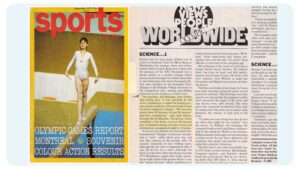
Injuries did not keep many athletes out of action in Montreal. Like for Bjorn Borg at Wimbledon this summer, there was always instant relief at hand. Borg used a spray but the panacea of the XXI Olympiad was a device similar to a battery charger which passes current through two rubber electrodes to neutralize pain and restore damaged cells. Ten were installed in the basement Polyclinique at the Olympic Village and more at the competition sites, making pain-killing injections as out-moded as a cinder track.
The machine, the Diapulse, goes farther than killing pain. It was reckoned by the clinic’s technicians to speed the healing process and give athletes, who previously would not have competed, a chance. “We can even assure them of between 60 and 90 minutes’ pain-free competition,” said chief physiotherapist Davie MacGee. The device, which resembles a little drum, is put on the injured part. It transmits energy via radio waves, and at full power can penetrate eight to 10 inches.
It was not only athletes who benefited. One International Olympic Committee member had a “trick” ankle which gave way and sent him crashing to the ground. After 20 minutes’ treatment he was walking again, although the last time it happened he had to stay off his feet for a week. Although few knew it at the time, when Jan Kodes won the 1973 Wimbledon singles after badly spraining his right ankle in the quarter-finals, it was this “battery charger” which cured him in 24 hours.
This was not the only wonder of modern science in the clinic. Athletes with pinched nerves or kinked necks could use a machine which resembled a “rack”. But whatever ailment you had, there was machinery to cure it, even if a pain-free Olympics did set the Games back $300,000. Ironically, when Dick Quax caught a stomach bug which sent his weight crashing by 5kg there was nothing he could do so close to his race. The drug he needed was on the banned list! Now if only there had been a machine . . .